Guides
Hair salon profitability: the numbers owners watch
Chair utilization, back-bar cost per service and rebooking rate decide salon profit. Here is the arithmetic owners can run on their own figures.
What to take away
- Chair utilization is booked service hours divided by available chair hours, and it caps everything else.
- Back-bar cost per service belongs in the price of the service, not in a year-end surprise.
- Rebooking rate tells you next month's revenue before next month starts.
- A no-show policy without a card on file is a wish, not a policy.
- Commission, booth rent and hourly change who carries a slow Tuesday.
Profit in a salon is not a margin you look up. It is what is left when service hours sold, cost of product, and the way stylists are paid line up in the same week. Four numbers tell you whether they do. Break-even adds a fifth: the point where contribution covers fixed cost.
Chair utilization is the ceiling
- chair utilization = booked service hours / available chair hours
- available chair hours = chairs x open hours
- contribution per chair hour = (service price - back-bar cost) / service duration in hours
A chair open ten hours with six hours booked runs at 60%. That number is the ceiling on everything downstream: no pricing change, no retail push and no marketing spend gets past it. Two levers move it, and they are not the same lever.
Chair utilization arithmetic
- 60%utilization 6 of 10 hours booked
- 10 hourschair open
- 6 hoursbooked service hours
- 90 vs 60 minsame price, different business
The first is filling empty hours. The second is shortening the service that occupies a booked one. A 90-minute color at $150 and a 60-minute color at the same $150 are different businesses, because the second leaves 30 minutes to sell again. Before you raise a price, check whether the service duration is what is actually costing you.
Where double-booking works and where it fails
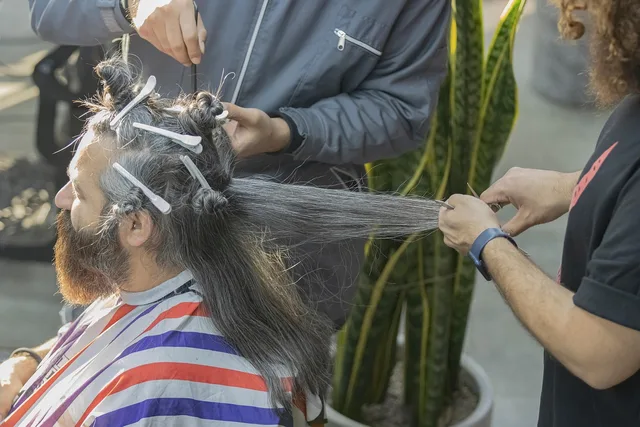
Double-booking means one stylist's chair holds two clients at once. It works in exactly one place: the processing window of a color service, when the client is under the dryer or developing and the stylist is idle.
Can this service be double-booked?
Is the stylist idle during processing?
overlap inside color processing window
same hands needed, do not overlap
It fails when the two services need the same pair of hands. A cut and a blow-dry cannot share a stylist, and a foil placement cannot be interrupted to greet a second client.
Two rules keep it from damaging the day: cap the overlaps per stylist per shift, and never let an overlap push the first client's finish time.
Roster against demand, not against habit
Demand in a salon is not flat. Saturday morning and Thursday evening carry different weight, and a roster built on equal shifts wastes the difference.
Who carries a quiet Tuesday
- Commission
- The stylist, partly
- Booth rent
- The stylist entirely
- Hourly
- The salon
Effect on rostering
- Commission
- Stylists push for the busy shifts and resist the quiet ones
- Booth rent
- The salon's income is fixed; the stylist decides their own hours
- Hourly
- You can schedule the quiet shift, and you pay for it either way
None of the three is correct in general. They differ in who absorbs the risk of a slow hour, and that decides how you build the roster. Under commission, the quiet shift needs a reason for a stylist to want it. Under hourly, you can staff it deliberately and watch utilization to see whether it earned its cost.
The consultation is a scheduling document
A color consultation is not a chat before the service. It is where the appointment length, the price and the patch test get decided.
Strand testing and the documented patch test before a first color service are the two steps that protect the appointment. The patch test happens before the booking, not on the day. The strand test tells you whether the hair's history supports the result the client is asking for.
When it does not, the answer is to refuse the service, not to shorten the processing. Chemical work follows the manufacturer's instructions for the product in use. Scalp and skin conditions go to a physician. Cosmetology licensing, sanitation and who may perform which service are set by your state board of cosmetology, and those rules vary by state.
A refused service is a lost chair hour, so the consultation is where you protect the schedule.
Back-bar cost and rebooking rate
Back-bar cost per service is the product consumed in one appointment: color, developer, foil, gloves, towels. Track it per service, not per month, because a monthly total hides which service is quietly unprofitable.
- back-bar cost per service = product used in the service x unit cost
- service contribution = service price - back-bar cost - stylist pay for that service
A two-hour color priced at $150 uses $18 of back-bar product. A 40% commission pays the stylist $60, so service contribution is $72. At two hours that is $36 per chair hour, and the same service cut to 90 minutes lifts it to $48 per chair hour.
Rebooking rate is the health metric. It is the share of clients who leave with their next appointment already in the book. A salon at 70% rebooking knows roughly what next month looks like. A salon at 30% is buying every client again through advertising, and that cost sits on top of everything above.
Break-even point
Fixed costs arrive whether the chair is booked or not: rent, utilities, insurance, software, card terminal fees, and any hourly front desk pay. Say they total $6,500 a month.
Break-even in services = fixed costs / contribution per service. Using the $72 contribution from the color example, $6,500 / $72 = about 90 services a month. Below that line the salon loses money on the month.
A typical net margin for an independent salon runs between 5% and 10% of revenue, so break-even is the floor, not the target. A salon that clears break-even but sits under 5% usually has a utilization problem or a back-bar problem.
Common questions
How do I price a service I keep losing money on?
Work the contribution line first. If service price minus back-bar cost minus stylist pay is thin, the fix is usually duration or price, not a cheaper product. Raising price on a service that already runs long and blocks a second booking rarely recovers the chair time.
Should a no-show fee be charged automatically?
Only if the client agreed to it before booking, which means a card on file and a stated policy at the time of the appointment. A fee applied after the fact is a dispute. Check what your state allows and what your card processor permits before you advertise it.
Card-on-file processing fees and chargebacks are a real cost, so price the policy before you post it.
How often should I recalculate utilization?
Weekly, on the same day, so the numbers compare. Monthly totals smooth out the Saturday that carried the week and the Thursday that did not. Advertising claims about your results must be truthful and supported, per the Federal Trade Commission guidance on advertising. A refund or a penalty lands on the same cost line as rent.
What records do I need to keep for this?
The Internal Revenue Service recordkeeping guidance covers income, expenses, payroll and assets. The Bureau of Labor Statistics occupational profile describes the work these numbers come from, including consultation, sanitation and scheduling. Recordkeeping is what makes the back-bar and fixed-cost lines auditable, and a missing receipt is a deduction you cannot claim.