
Guides
Hairdresser Stylist Rosters in Ontario: Weekend Rotation and Scheduling
Hairdresser stylist rosters in Ontario: how to build a fair weekend rotation, keep the trade log current, and schedule around the Employment Standards Act.
What to take away
- Hairdresser stylist rosters hold two recordsthe shift schedule clients book against, and the pay model behind it.
- In Ontario, the Employment Standards Act, 2000 sets the three-hour rule: an employee who regularly works more than three hours a day and is sent home early is owed three hours' pay.
- A weekend rotation holds when the cycle is published before the month starts.
- Booth renters set their own hours, yet their chair sits on the same roster so the desk cannot double-book it.
- No-show rules and deposits are roster decisions. An empty slot is a paid hour nobody billed.
Who appears on a hair stylist roster
Four groups sit on a salon roster: the owner-operator, hourly employees, commission stylists, and booth renters. Their pay model decides who absorbs a dead hour, which is why booth rent vs commission hair salon pay is worth settling before you build a schedule.
An hourly stylist sent home at 11 a.m. on a quiet Tuesday is still owed three hours, so the salon carries the cost. A commission stylist earns nothing for that hour, while a booth renter pays the same rent whether the chair was busy or not.
How a weekend rotation works
Saturday fairness is a scheduling problem, not a personality problem. Build the cycle in five steps.
- List who can work Saturday. A stylist without childcare is not an option, whatever the contract says.
- Set the cycle length. Four weeks suits a six-chair salon, and larger teams often run six.
- Publish the cycle before the month starts so clients can book around it.
- Put trades in writing and update the booking system the same day.
- Count Saturdays worked per stylist at the end of each cycle, then correct the imbalance.
Small salons skip that review and drift back to whoever asks first. Our weekend roster for hair stylists puts the cycle on a calendar, with the trade log attached.
What each pay model means for the roster
Pay model changes who carries a Saturday when the chair is empty.
Who pays for the chair
- Hourly employee
- Salon
- Commission employee
- Salon
- Booth renter
- Renter
- Owner-operator
- Owner
Who absorbs an empty hour
- Hourly employee
- Salon
- Commission employee
- Stylist, through lost earnings
- Booth renter
- Renter
- Owner-operator
- Owner
Weekend effect
- Hourly employee
- Hours past 44 in a week are overtime in Ontario
- Commission employee
- A quiet Saturday still costs the stylist the day
- Booth renter
- Rent is fixed, so the loss is the missed service income
- Owner-operator
- Owner covers rent and payroll from other days
The table is illustrative, not a rate card.
For Ontario, the Employment Standards Act, 2000 and the official Your Guide to the Employment Standards Act: Hours of Work explain when a short shift has to be paid. That rule decides whether an early cut is a schedule tweak or a payroll cost.
At an illustrative 40 percent split on a $60 cut, the stylist keeps $24 before tax. The commission split calculation decides whether a full Saturday beats an hourly week.
Example: a six-chair salon in Hamilton
Six chairs: three commission stylists, two booth renters, and one owner-operator who still cuts on Saturdays.
Every stylist wants the 9 a.m. to 2 p.m. block on Saturday, not the 2 p.m. to 7 p.m. tail.
The owner posts a four-week cycle. Each stylist works two full Saturdays and one half Saturday. Trades need a note to the front desk before the swap takes effect.
The first cycle broke when a renter traded a Saturday for a Tuesday and told nobody, so a client arrived to a booked chair with no stylist behind it. Nobody was paid for that hour, and the booking system showed an open chair all afternoon.
The fix was a one-page trade log the desk updates before close. The Ontario Ministry of Labour enforces what an employee schedule has to record under the Employment Standards Act, 2000 schedule rules, and the same discipline keeps renters visible on the board.
Records, no-shows and deposits
A roster only holds up if the paper behind it does. Ontario's official Your Guide to the Employment Standards Act: Record Keeping sets out what an employer has to log for hours worked.
Keep those records for as long as the Act requires, and keep them where you can pull one stylist's week in under a minute.
No-shows cost more than the slot. A deposit policy needs to be in writing before the client pays.
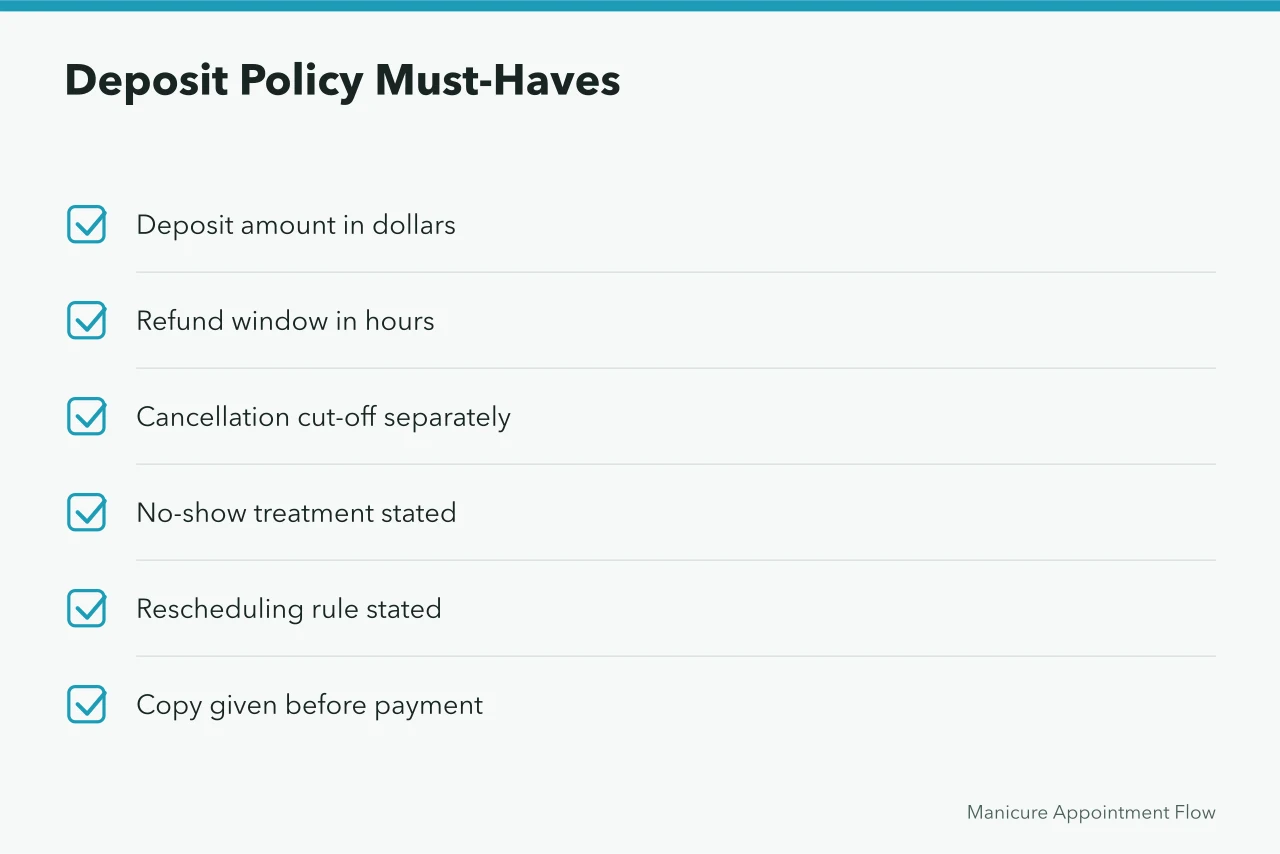
The salon that keeps a deposit is the salon that showed the term first. When a swap moves a client into a chair the roster does not cover, that written term is the only thing standing between the salon and a free hour.
Common questions
Who pays when a client no-shows on a Saturday?
That depends on the pay model, and the desk should not invent an answer. A hair salon no-show policy that names the grace period and the deposit line gives everyone the same written term.
Can an employee refuse a Saturday shift?
An employee can refuse, but the schedule is the employer's to set.
How far ahead should the roster go up?
Publish two weeks out so clients can book and stylists can plan childcare.
Do booth renters belong on the roster?
Yes, for booking. A renter sets their own hours, but the desk needs to see which chair is open.