Guides
New vs used hair salon equipment: which items to buy new
New vs used hair salon equipment: four acquisition routes compared, plus the items worth buying new and the items that are a reasonable used risk.
What to take away
- Compare new vs used hair salon equipment on cost of ownership, not on the price on the tag.
- The hidden term is service timean item that slows a stylist costs money every appointment.
- Some items are worth buying new for reasons that have nothing to do with reliability.
- No route removes the obligation to commission the item before it goes on the floor.
Buying used is neither thrift nor false economy in general. It is right for some items and wrong for others, and the split is predictable once the comparison is set up correctly.
Cost of ownership, not purchase price
Cost of ownership
- cost of ownership = purchase price + delivery and installation + repairs over the holding period - resale value + service time cost
- service time cost = extra minutes per service x services over the holding period x contribution per minute
The second line decides most of these comparisons, and nobody puts it in a spreadsheet. If an item adds time to every service, that time is chair time. Chair time is the scarce resource. The formula only works with your own numbers, so collect purchase, delivery, installation and repair quotes and run them in the same columns against the used alternative.
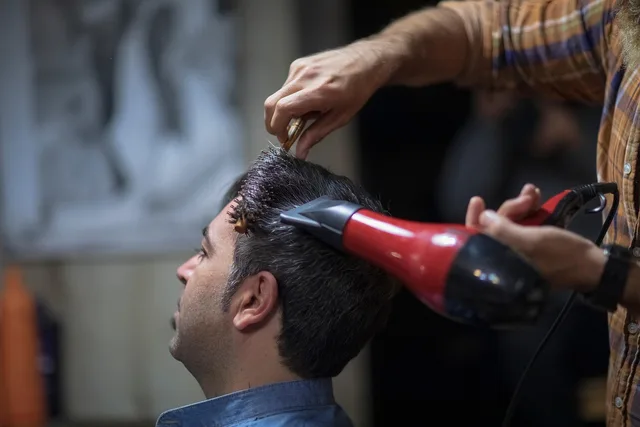
Service time is also what a stylist roster is built from: the minutes an item adds per service set how many clients a stylist can carry in a shift. Equipment that wastes time shows up in the roster before it shows up anywhere else.
Cost of ownership formula
- Purchase priceopening outflow
- Delivery and installationadded cost
- Repairs over holding periodadded cost
- Resale valuesubtracted
- Service time costextra minutes x services x contribution per minute
A chair that is awkward to raise, a dryer that must be repositioned, a bowl uncomfortable enough to need adjusting: all show up there rather than in the price.
Four acquisition routes compared
Where it wins
- New from a supplier
- Warranty, parts, known condition
- Refurbished from a dealer
- Some warranty, lower outflow
- Used private sale
- Lowest outflow
- Lease or finance
- Smallest opening outflow
What it costs you
- New from a supplier
- Highest opening outflow
- Refurbished from a dealer
- Limited model choice
- Used private sale
- No warranty, no recourse
- Lease or finance
- Fixed monthly obligation from day one
The risk to check
- New from a supplier
- Lead times that slip past your opening date
- Refurbished from a dealer
- What "refurbished" actually covered
- Used private sale
- Condition, and whether parts still exist
- Lease or finance
- The obligation starts before the book fills
The fourth is a financing decision wearing an equipment decision's clothes. It converts an opening cost into a monthly one, which helps the opening requirement and hurts the runway. Judge it as a funding choice.
Four acquisition routes
New from supplier
- Where it wins
- Warranty, parts, known condition
- What it costs
- Highest opening outflow
- Risk to check
- Lead times slip past opening
Refurbished dealer
- Where it wins
- Some warranty, lower outflow
- What it costs
- Limited model choice
- Risk to check
- What refurbished covered
Used private sale
- Where it wins
- Lowest outflow
- What it costs
- No warranty, no recourse
- Risk to check
- Condition and parts availability
Lease or finance
- Where it wins
- Smallest opening outflow
- What it costs
- Fixed monthly obligation from day one
- Risk to check
- Obligation starts before book fills
Which items are usually worth buying new
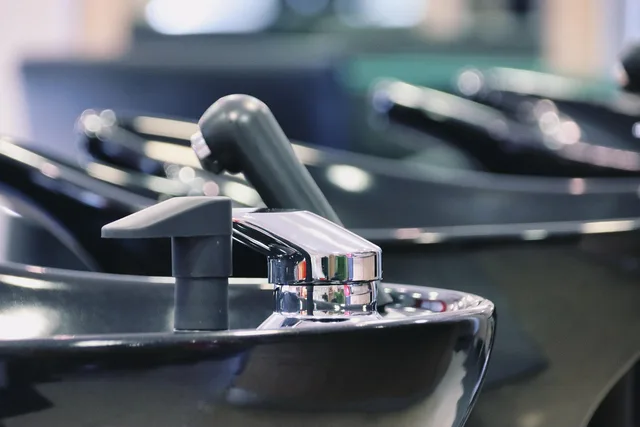
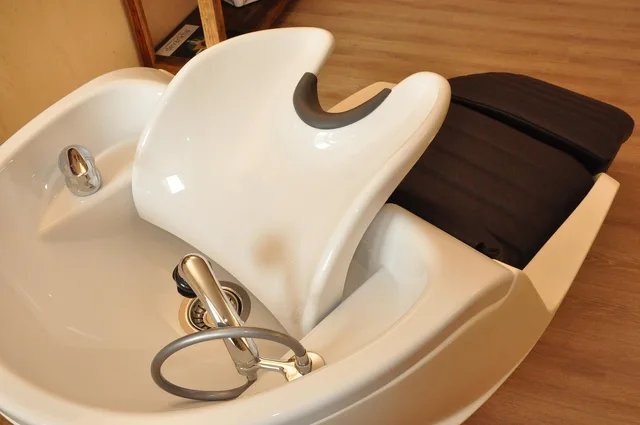
- Wash units and shampoo bowls. Anything plumbed is installed once, and replacing it later is a plumbing project. Bowls also carry a cleaning duty: Maryland's salon sanitation rules require shampoo bowls to be washed after each shampoo and sanitized frequently with a disinfectant, and a bowl whose surface has gone porous or crazed cannot be brought back to that standard.
- Styling chairs and dryer chairs, anything a stylist stands at all day. Small ergonomic faults become minutes, and minutes become the service time term above. The case for new here is chair time, adjustment mechanisms and parts rather than disinfection: Texas barbering and cosmetology rules provide that chairs and dryers do not need to be disinfected before each client.
- Anything where parts availability decides the repair. An obsolete model with no parts is not repairable at any price.
- Anything electrical whose condition you cannot verify, since the risk there is not financial.
- Anything with a hygiene surface that cannot be properly disinfected, such as chair upholstery that has split or gone sticky. A surface that cannot be cleaned caps the life of the item, not just its looks.
Which items are a reasonable used risk
- Storage, shelving and trolleys, where age affects appearance and little else. They still have to do a job: Ohio's cosmetology rules require used or unclean equipment and implements to be stored separate and apart from clean items and to be cleaned and disinfected before use.
- Reception furniture and waiting seating.
- Mirrors and non-electrical station fittings.
- Retail display units.
- Processing seating, provided the upholstery cleans to a standard you can defend.
The pattern is simple. Items whose failure mode is cosmetic are good used purchases. Items whose failure mode is time, hygiene or safety are not.
What none of the routes solve
None changes the chair count the room supports, which the geometry in our equipment and setup guide fixes. None removes the commissioning step. Every item passes its acceptance test before it goes on the floor, which is what our equipment checklist for new owners is for, and a used item needs that test more than a new one.
None changes who may use what. Permission follows from the levels in the hiring and training guide. Sanitation rules for anything touching a client are set state by state — the bowl and storage rules quoted above are examples — and the paperwork behind them sits in the licensing and compliance guide.
None touches how services are performed. Chemical work follows the manufacturer's instructions for the product in use, after a documented consultation and, before a first color service, a documented patch test. Scalp and skin conditions are for a physician.
Workplace safety obligations apply to used equipment exactly as to new; see the Occupational Safety and Health Administration guidance on safety management. The Food and Drug Administration fact sheet for salon professionals covers the product side, and the Bureau of Labor Statistics occupational profile describes the work these items support.
Common questions
How long a holding period should the formula use?
The period you can honestly commit to, which for a first salon is often the lease term. A longer period flatters used purchases, because it spreads repair cost over years you may not be there for.
Is resale value worth modeling?
For plumbed and installed items, rarely, because removal costs eat it. For freestanding items in good condition it is real, and it is the term that makes buying new less expensive than it first appears.
What about equipment inherited with a lease?
Treat it as a used purchase you did not choose. Commission every item, price the replacement of anything that fails, and negotiate on that basis rather than accepting it as a benefit.
Does buying used affect insurance?
It can affect how property cover treats the items and what an insurer expects of their condition. Ask directly rather than assuming the fit-out is covered at replacement value.